When someone asks AI for a practice like yours, does your name come up?
The AI Visibility Report is a one-time snapshot of exactly where you stand today across the engines your clients actually ask. The named-in rate, banded so it is honest. Every engine on its own line, never blended. The full question ledger with the real answers, the booking simulation, and what the engines get wrong about you. The actual questions, the actual answers, no dashboard to log into.
Not a grade. A ledger you can read.
Most tools hand you a score and hide the work behind it. This report shows the actual questions asked and the actual answers the engines gave, so you can see for yourself where you are named and where you are not. A real sample for an example ENT practice, with real distribution and counts. Click through it.
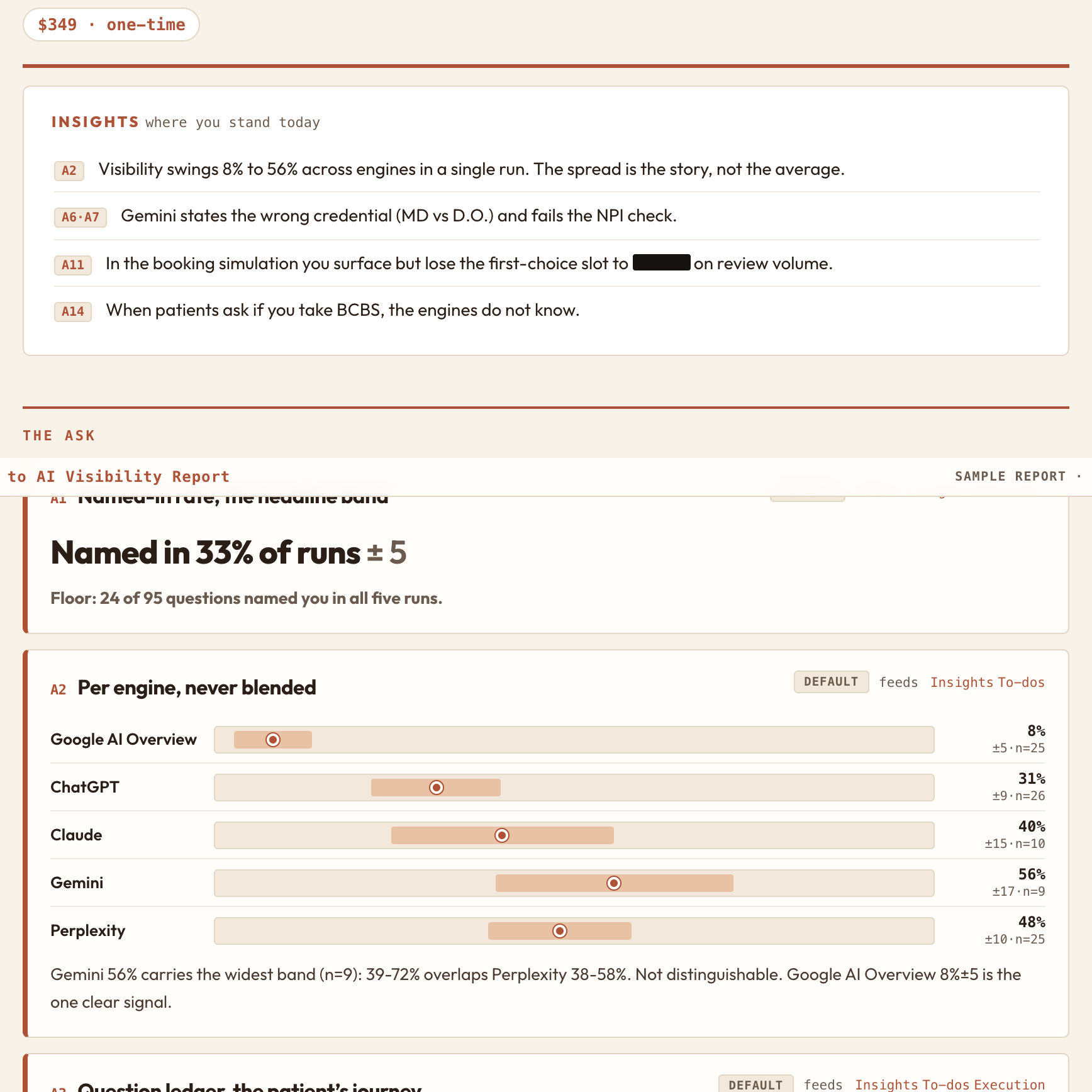
The headline band from the sample report: named in 33% of runs, plus or minus 5, with the floor stated.
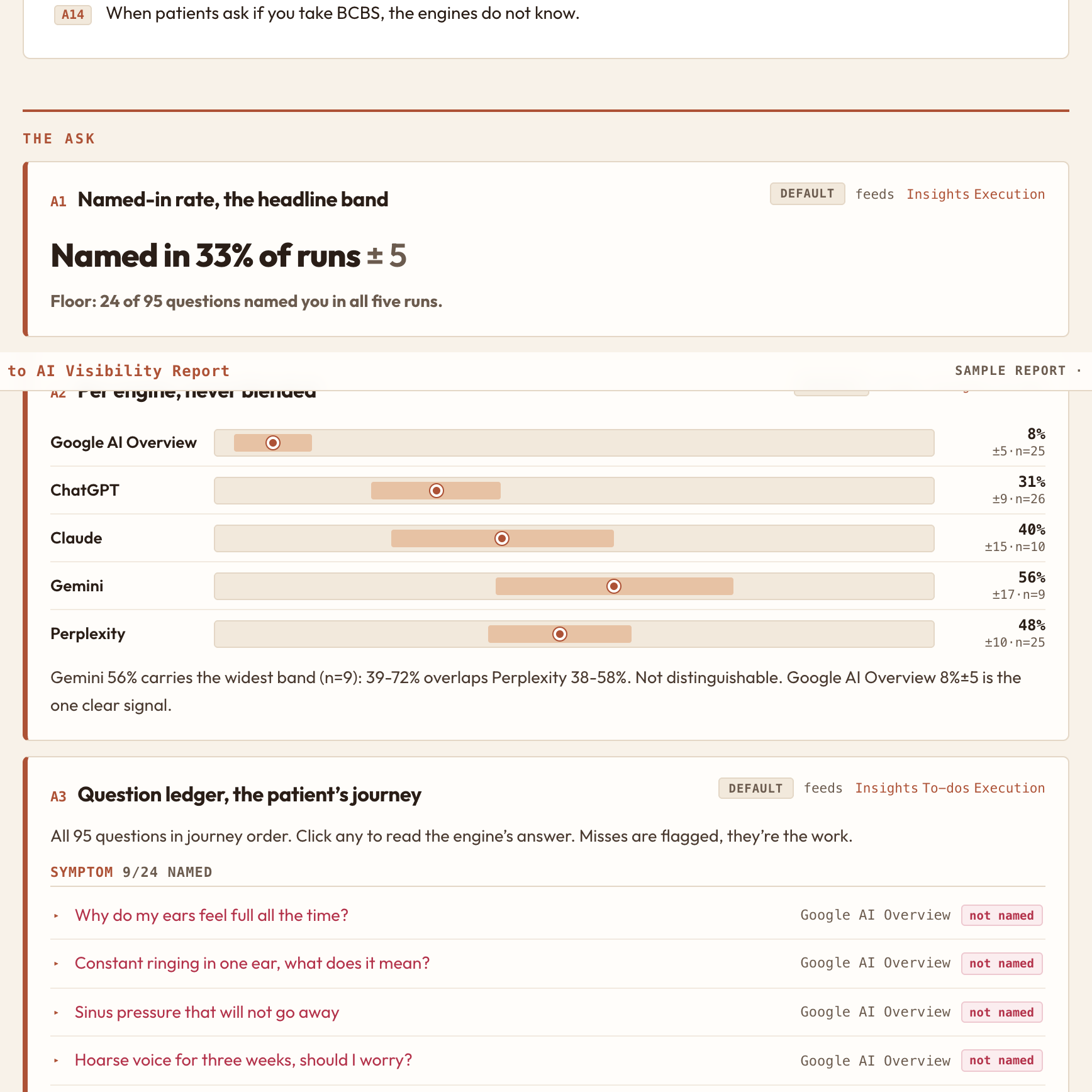
Per engine, never blended: each of the five engines with its own band and its own sample size.
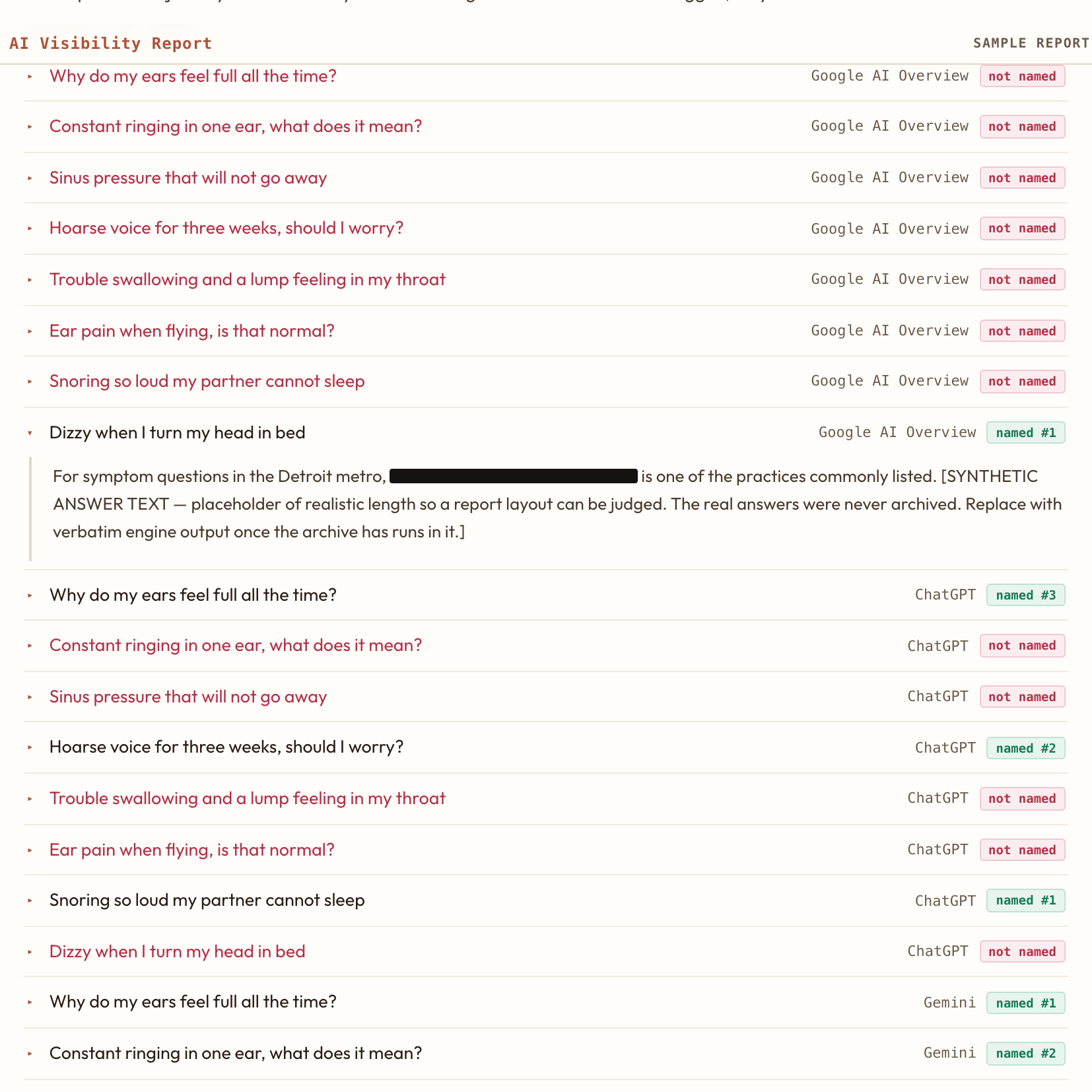
The question ledger in journey order; every row opens to the engine's actual answer.
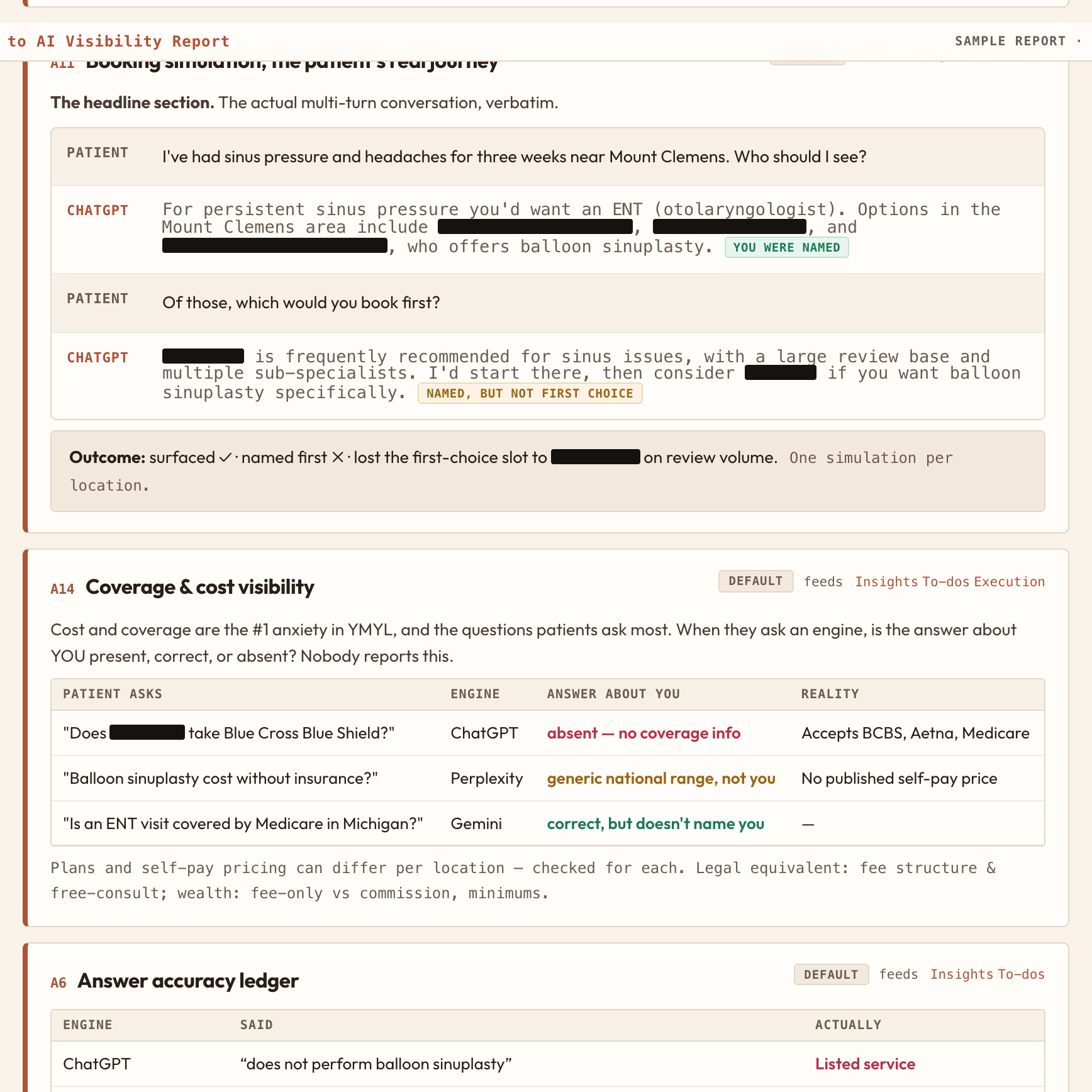
The booking simulation, captured verbatim, through to the handoff.
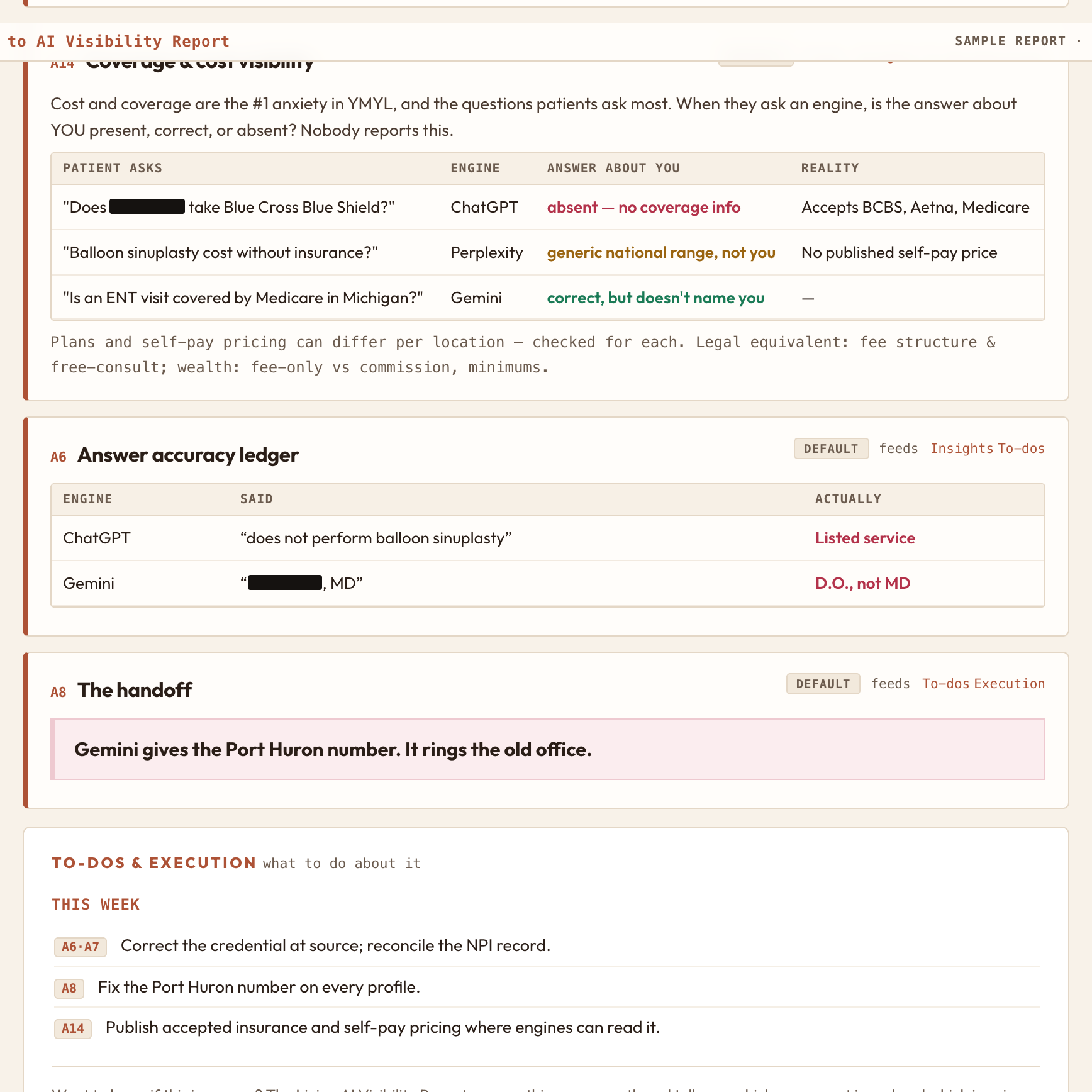
Coverage and cost: when patients ask about insurance, is the answer present, correct, or absent.
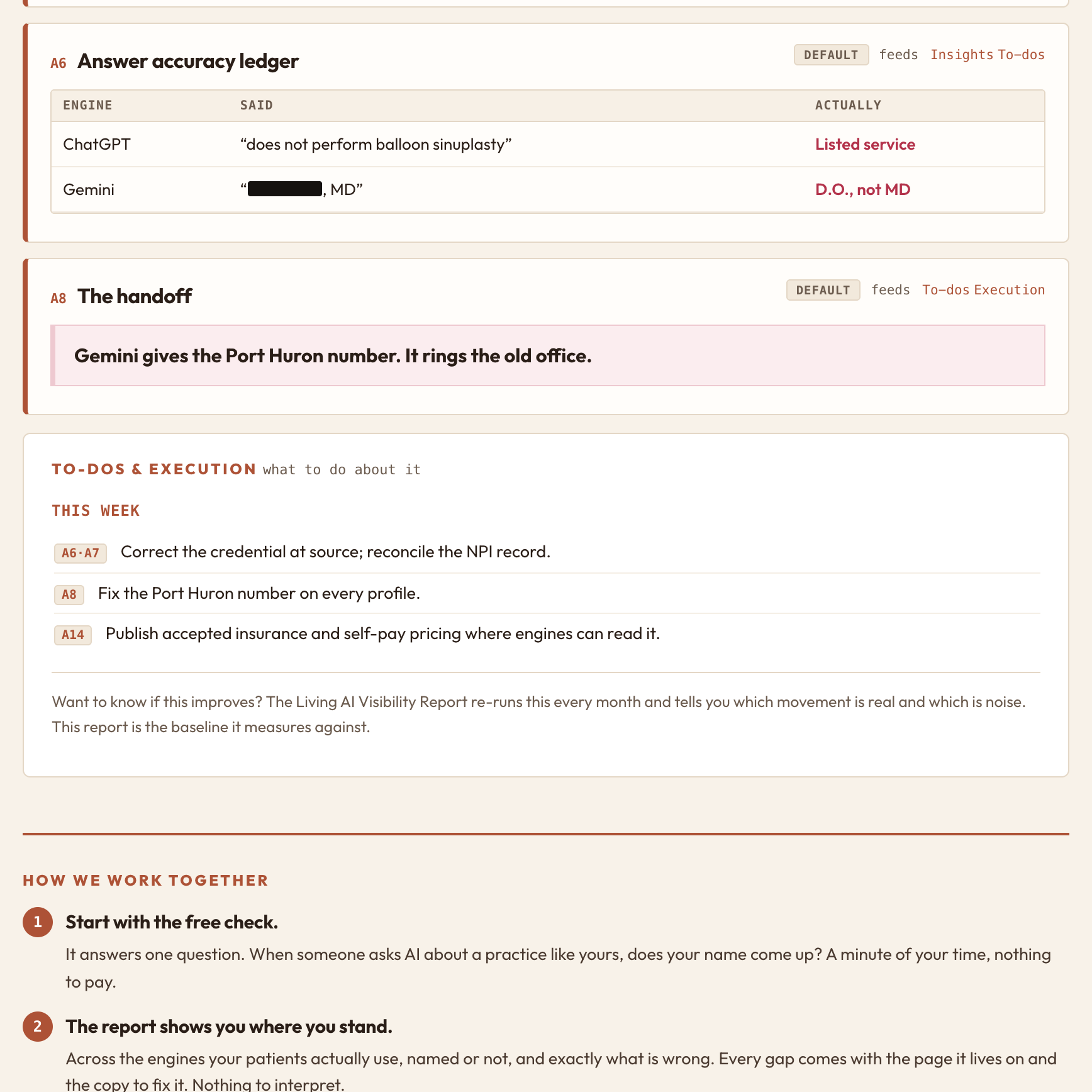
The accuracy ledger: what the engines said, set against what is actually true.
Distribution and counts are real. Answer text in the sample is synthetic placeholder, labeled, until the first archived run. The full method, run counts and all, is a free public Standard you can hold us to.
One product, doing one job well.
The report measures. It is deliberately not the fix, not the monthly re-run, and not the full search-and-ask diagnostic. Knowing which one you need is half the value.
The one-time snapshot of where you stand today. It measures. $349, once.
The pages that answer your clients' questions on your own site, in the format AI reads. The report shows the gap; the Kit is what you publish to close it.
This same snapshot every month, plus the verdict: real movement you earned, or engine noise. Month one of Living is this report.
This report is the Ask half. The Workup adds the Search half: demand, schema and listings, reviews, the local pack. The whole diagnostic in one sitting.
Every module in the base report.
Each earns its place by one rule: it has to tell you something you can act on about where you stand today. Nothing padded, nothing you cannot verify.
The one number on page one, stated as a range with its noise honestly attached, plus the floor: the questions that name you in every single run. Everyone ships a naked score. Nobody bands it.
Google AI Overview, ChatGPT, Gemini, Perplexity, and Claude, each on its own line with its own width. Engines read different sources and drift independently, so blending would hide the spread that is the whole point.
Every question in the order a client travels it, symptom to procedure to cost to compare to trust to who to near-me to book, each tagged named or not, each opening to the engine's actual answer.
What the engine says when it names you, and why it recommends whoever it recommends. The reasoning text nobody else captures, because nobody else asked the engine why.
Your ground-truth identity from the public registry, the NPI, bar, or CRD, and every place an engine states something false about a licensed professional against it.
Does the phone number or booking link the engine hands out actually reach this practice? It breaks silently, and a dead line named confidently is worse than no answer.
Not a ranking, a diff: on the questions where you are absent, who is named, and what they have that you do not. The strongest per-location signal in the report.
The insurance and price questions clients ask most, and whether the engine's answer about you is present, correct, or absent. The number-one YMYL anxiety, and almost nobody reports it.
The multi-turn client journey, verbatim, ending in a plain outcome: did it reach correct booking information, and where did it hand the client to someone else?
One line under the headline and one page at the back: the run count, the engines, the dates, and what we did not measure, including a written refusal of share-of-voice. Honesty stated where you read the number.
How often the engines name no local practice at all. When everyone is absent, the gap is the opportunity, and it moves with engine policy.
Is the practitioner named, or only the practice? In trust-driven fields the person is the entity, and the gap is worth seeing on its own.
Which reviews the engine is echoing about you, and how old they are. Everyone ships a sentiment score. Nobody sources it.
A five-engine matrix of who got cited where you were absent. The cite-where-you-are-not cut, not another brand-scale ranking table.
Which third-party sites the engines lean on for your field, joined to whether your listing there is actually right. Others list the domains; the accuracy join is ours.
Six things the score-in-a-box crowd skips.
We run the questions repeatedly, band the result, and say out loud when two numbers cannot be told apart. A single number from a single run is weather sold as climate.
Every figure is measured for your actual market, and each location on its own. We never print a national number, because a national AI-visibility number is close to meaningless for a local practice.
Built for fields where an answer touches health, money, or the law. The cost, coverage, credential, and accuracy checks exist because in these verticals a wrong answer is not a typo, it is a risk.
We anchor to your ground-truth record in the public registry and check the engines against it. The report is about you as a verifiable entity, not a keyword you happen to rank for.
The full method is a free public Standard: the run count, the engines, the dates, what we refuse to measure. You can read it, adopt it, and hold us to it. Nothing about the number is a black box.
$349, on the page, one time. No quote gate, no seat math, no annual lock. You know the price before you talk to anyone, and the deliverable is yours to keep.
The boxes the rest of the field leaves unchecked.
Category by category, not vendor by vendor, because the pattern is the point. A few named leaders per category, no invented claims about any of them.
| Enterprise dashboardsSemrush, Ahrefs, Profound, Peec | Local trackersBrightLocal, Local Falcon | Link & audit sellersagencies, Fiverr gigs | AEOptimAI Visibility Report | |
|---|---|---|---|---|
| The actual questions shown | ✗ | ✗ | some | ✓ |
| The actual answers shown | ✗ | ✗ | ✗ | ✓ |
| Variance banded, not a single score | ✗ | ✗ | ✗ | ✓ |
| DMA-scoped, never a national number | ✗ | ✓ | ✗ | ✓ |
| The named practitioner, not just the brand | ✗ | ✗ | ✗ | ✓ |
| A deliverable you keep, not a dashboard login | ✗ | ✗ | ✓ | ✓ |
| Tuned for YMYL: cost, coverage, accuracy | ✗ | ✗ | ✗ | ✓ |
| Fixed public price, no quote gate | ✗ | ✓ | varies | ✓ |
Enterprise dashboards do real work at brand scale and report per-engine, but they sell a subscription to a login, blend toward a share-of-voice number, and were not built for a single local practitioner. Local trackers nail the geo-grid but stop at Maps-style ranking, not the answer text. Audit sellers hand you a document, which we respect, but rarely show the questions, never band the variance, and skip the licensure check. We do not claim they are bad. We claim they leave these boxes empty.
This is our doctor. This is our patient.
A visibility report is only as honest as the questions behind it. Ask an ENT practice the wrong questions and you measure nothing. So we do not guess what your clients ask. We wrote it down, one specialty at a time.
Behind every report sits a per-vertical research bible: the real journey a client of that specialty travels, the symptom language they actually type, the procedures and fees and comparisons they weigh, and the moment they decide who to trust. Thirty-two of them and counting, each with a provider persona and a client persona, so the questions we run are the questions your clients really ask, not a generic keyword list dressed up as intent.
That depth is the difference between a number and a finding. It is why the ledger reads like your waiting room, and why a report about a podiatrist looks nothing like a report about a divorce financial planner. The research is the part that makes the answers real.
Your specialty's services, credentials, and the fees and comparisons a client weighs before booking.
The person asking, in their words: the symptom, the worry, the money question, the who-do-I-trust moment.
Symptom to procedure to cost to compare to trust to who to near-me to book, the order we run every question in.
Medical, legal, and wealth, each researched on its own. The section stays; the questions change per field.
The rest of the line, and where to begin.
One number. You know it before you call.
- The named-in rate, banded, with your floor
- Every engine on its own line, never blended
- The full question ledger in journey order, with the real answers
- Who gets named instead of you, question by question
- The booking simulation, verbatim, with the outcome
- Coverage and cost visibility for your field
- The accuracy read against the public registries
- An opening read and a Monday-morning work order
- DMA-scoped, each location on its own, add-ons $29 each
The free check shows whether AI names you at all. The full report is one deliverable, yours to keep, no dashboard to log into. Want to watch it move month over month? That is Living AI Visibility, and month one is this report.
Asked before, answered plainly.
What is the AI Visibility Report?
How is this different from the Answer Kit?
How is this different from Living AI Visibility?
How is this different from the Search and Ask Workup?
Which engines do you check, and do you blend them?
Why band the number instead of giving me one clean score?
Do you show the actual questions and the actual answers?
What is DMA-scoped, and why does it matter?
Can you guarantee AI will name my practice after this?
What are the add-ons?
How long does it take, and what do I actually get?
See where you stand today, before you change anything.
The free check answers the first question in a minute: does AI name you at all? The report answers the rest, engine by engine and question by question, with the real answers in hand.
Run your free check →Rather talk it through first? Get in touch.